Propagating Plants with Stem Cuttings
I’m a thrifty gardener. I like save money in any way I can, so I use material I can find in my local area (like all those rocks), mix my own potting mix, make compost, collect leaves, and pretty much anything that will help save me money when it comes to gardening. One thing saves me a bundle is propagating my own plants.

Spring is when I’m busy propagating plants for the new garden areas. Most perennials can be propagated either by saving seed, dividing them when they’re mature, or taking root or stem cuttings. My favorite way to propagate plants is by stem cuttings, it really couldn’t be any easier.

I’m using a catmint plant for this demonstration. Catmint is one of the workhorses in my garden, I find myself propagating tons of these and using them everywhere.

Fill some pots with soil mix or vermiculite then water and poke a hole it in with a pencil. You want the holes so that the rooting hormone doesn’t get wiped off when you put the cutting in it. I like to use my own mix of 50% peat and 50% medium vermiculite, sometimes I use 100% vermiculite (you can use perlite instead of vermiculite, I’m just not a fan of perlite feels too much like styrofoam for my liking).

Take some stem cuttings from the plant you want to propagate, make sure it’s new growth (unless you’re doing hard wood cuttings for things like hydrangeas and boxwoods). I like to cut pieces that are 3-6 inches long. You can to cut a centimeter or two below a leaf node, then strip off the lowest leaves. Roots will form from these nodes, so you want to make sure you have at least one of these under the soil level.

Dip the stem into rooting hormone making sure to get some on the nodes. Then insert the cutting into the pot and press the soil gently around the cutting. (make sure to not breathe rooting hormone and wash hands thoroughly when finished, or order natural rooting powder from Richter’s – I’ll be getting some when I use up this bottle of rooting hormone)

Place tray of cuttings in a sheltered location and keep well watered and if desired covered with plastic or a dome (I don’t always cover mine I just mist with water). I like to keep mine in a tray and water from below and mist the leaves frequently to keep leaves moist. Make sure they’re in a shaded location or in the garage by a bright but not too sunny window, if they get too much sun the plants will lose too much water or cook under the plastic. Right now I have all kinds of trays of cuttings in various sheltered spots around the garden and in the garage. At the moment, I’m trying to propagate: lemongrass, dumb cane, hydrangeas, viburnum, clematis, boxwood, black elderberry, salvia, sedum, thyme, kennelworth ivy, and catmint.

Remember to propagate more plants than you think you want, you’ll have some that don’t survive. I usually have a 75-80% success rate depending on the type of plant. Some plants propagate better than others, so don’t get discouraged if you fail. Try again with a different kind of plant. Sedums, catmint, hydrangeas are pretty much no-fail when it comes to propagation.
Do you or have you propagated plants for your gardens?
Share this:

An Wonderful Inconvenience
It’s about a mile and half to our voting station. Since it was a beautiful late afternoon we decided we’d walk down. We took Lucy with us and she was very tired and slow on the way home, most likely a combination of her age and her injury. We were walking slowly up the big hill, bemoaning how slow she was now and how we’ll have to only take her on shorter walks, when all of a sudden Mr Chiots spotted a morel, a nice big one. I jumped over the ditch and grabbed it, then noticed a few more. We picked the ones we saw then headed home with plans of heading out a little later.

We headed out again in the evening and found another half pound of nice amber and white/gray morels. We got back too late to get photos of the amber ones, I’ll definitely try to get some today to put up on Flickr (here they are). While we were hunting for mushrooms, we talked about how earlier we had been complaining about Lucy being so slow. But it was her slowness that allowed us to spot the morel. Sometimes things that seem like an inconvenience can be of great reward!
Have you ever had something that was an annoying inconvenience turn into something wonderful?
Share this:

New in the Garden: a Pond
We’re always trying to find ways to make our little gardens an oasis for creatures of all shapes and sizes (minus the big rodent like white tailed deer, we could live without them). We put up birdhouses and put out seed for our feathered friends. We have boards and rocks and upturned pots around the gardens for toads, salamanders and snakes. We have bamboo for native bees and a hive of honeybees. We have saucers filled with rocks and water for all the small insects, birds, and other creatures. One thing we’ve been lacking is a small pond for frogs.

My sister had this pond in her house when she moved in and didn’t want it. My parents took it to their house and installed it in their gardens. After several years they decided they wanted a bigger one. Naturally, this one then was handed down to us. We’ve had it for a year or two and could never decide where to put it (not to mention muster up the energy to dig a hole in our rocky soil large enough for it).

We finally figured out where to put it. Last year we cut down a crabapple tree in the front yard that was languishing. I think it was diseased or something, it never looked healthy and all of our attempts to give it manure and prune it were thwarted by more ugliness and lack of blooms. Last week Mr Chiots decided to dig up the stump. We were left with a large hole and thought it would be perfect for our “new” pond. Sure enough the pond almost fit, a little more digging and it looks like we’ll have a pond in the gardens soon.


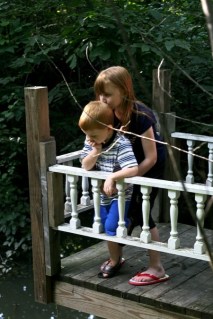
My parents have a nice sized small pond and a second big detention basin filled with fish and frogs (photos above and below). We’ll be able to get a few water plants off them and a few tadpoles. I may even buy a fish or two for it. Our nieces and nephew think grandma & grandpa’s ponds with fish are great. Every time they go to my parents for a visit they have to go out and see the fish & frogs in both ponds.

I’m hoping this will help attract even more varieties of species to our gardens. Not to mention it will be a nice feature in the front garden!
Do you have any water features in your garden?
Share this:

Quote of the Day: E.E. Cummings
“The earth laughs in flowers.” ~ E.E. Cummings
This time of year the earth is simple giggling, it will give way to a huge belly laugh soon. I can’t wait!

The columbine’s are graceful and delicate set high above their lacy foliage. They seed freely and grow all over the place, including the driveway. This late blooming light pink tulip among these lamb’s ears is just a perfect combination!

The chives are starting to bloom and they’re so lovely. We’ve been eating them on everything! They are growing all over the gardens tucked in to little spots here and there.

The rock geraniums are just starting to bloom, they’ll bloom beautifully all summer long cascading over the rock wall on the front hillside.

The single late tulip ‘Negrita’ is really wonderful. I’m particularly fond of dark flowers like this. I’ll have to move some lamb’s ears around these tulips, that would be another striking combination.

The dogwood blooms are going to fade soon, they’re such graceful flowers. I’m always sad to see them go.

I love the spring, all the flowers seem to be delicate and lovely. But my favorite time of year for flowers is the early summer. The gardens are riotous with blooms and everything is a mass of color. Perhaps that’s my love of cottage gardens showing through.
What’s your favorite time of year for flowers?
Share this:

Fresh Laundry
I’ve always been picky about my towels and sheets. I never quite knew why it was that I couldn’t stand fabric softener or fragrance when it comes to laundry, particularly sheets and towels. I always felt like towels and sheets didn’t feel “clean” or something when they were washed with fabric softener (and let’s not even get started on overwhelming fragrances). I feel like towels with fabric softener don’t dry or soak up water and hate the feeling when using them. I always described the feeling I was looking for as “crispy”. Then a few years ago I started drying my laundry outside and realized why.

I grew up with line dried clothes. We lived in South America where it was hot and dry. We line dried the clothes so the cotton sheets and towels got that stiff feeling. That’s what I love. I noticed that the towels are kind of scratchy when I get them off the line and I love it! I feel like they actually dry instead of just the smearing water around.

They also smell fantastic, or actually don’t smell of anything, which is wonderful. Now that it’s warm, I am able to have crispy sheets and towels again – and how great it is!

And besides, laundry looks wonderful drying in the garden, who needs garden art when you’ve got fresh laundry on the line.
So what about you, any weird laundry issues? Do you line dry any laundry?

